Every fact on this list survived the “no way, let me check” test. That’s the standard: if it doesn’t make someone reach for their phone in disbelief, it didn’t make the cut.
Things that are the wrong size
Russia is wider than the Moon
East to west, Russia spans about 9,000 km. The Moon’s diameter is 3,474 km. You could lay two and a half Moons across Russia and still have Siberia left over. Australia beats the Moon too, which feels like it shouldn’t be allowed for a single country.
Canada has more lakes than the rest of the world combined
Somewhere around 880,000 of them, by most counts. Nine percent of the country is fresh water. There are lakes in Canada that have islands with lakes on them — which have their own islands.
The deepest trench could swallow Everest — with room to spare
Drop Mount Everest into the Mariana Trench and its summit would still sit about 2 km below the surface. More people have walked on the Moon than have reached the trench’s deepest point.
Norway’s coastline could wrap around the planet twice
Count the fjords and the islands and Norway’s coast runs past 100,000 km — on a country you can drive across in a day at its narrowest. Coastlines get longer the closer you measure them, which is a real mathematical headache called the coastline paradox, and Norway is its poster child.
90% of people live in the Northern Hemisphere
The south got the oceans; the north got the land — and almost everyone on it. Flip a globe upside down and you’re looking at water with occasional interruptions.
Water doing strange things
Sailors drank from the ocean before they could see Brazil
The Amazon pushes so much fresh water into the Atlantic that it stays drinkable far offshore. In 1500, the explorer Vicente Yáñez Pinzón noticed his crew was sailing in fresh water — and turned toward a coastline nobody on board had seen yet.
There’s a lake that stays pink in a bottle
Lake Hillier, on an island off Western Australia, is bubble-gum pink. Scoop the water into a jar and it stays pink. Salt-loving microbes get the credit — and the lake sits a few hundred metres from the regular blue ocean, which makes the aerial photos look photoshopped. They aren’t.
The Atlantic is growing at fingernail speed
The Atlantic widens a couple of centimetres a year — about as fast as your nails grow — while the Pacific quietly shrinks. America and Europe are drifting apart at a measurable, slightly melancholy rate.
Parts of the Atacama have never seen recorded rain
Some weather stations in Chile’s Atacama Desert have been waiting their entire operational lives for a single millimetre. NASA tests Mars rovers there because it’s the closest thing Earth offers to Mars. There are riverbeds in it that geologists believe have been dry for thousands of years.
The Sahara has cave paintings of people swimming
In the driest part of Egypt’s Western Desert there’s a cave wall covered in tiny painted figures, mid-stroke. Around 8,000 years ago the Sahara had lakes, grass, hippos. The “Cave of Swimmers” is the green Sahara’s goodbye note.
Maps behaving badly
France’s longest land border is with Brazil
Not Spain, not Germany — Brazil. French Guiana, on South America’s northern coast, is as much France as Paris is: same currency, same president, EU territory with a rainforest. Its border with Brazil runs about 730 km.
The Netherlands and France share a land border — in the Caribbean
The island of Saint Martin is split between the two. One island, two countries, no fences, and a border that exists mostly as a sign you can stand next to for a photo.
Kiribati is the only country in all four hemispheres
Its islands straddle both the equator and the 180° meridian. In 1995 it bent the International Date Line around itself so the whole country could share one calendar — which also made it the first country on Earth to enter each new year.
All of China runs on Beijing time
A country wide enough for five time zones uses exactly one. In the far west, “noon” can mean the sun is barely up, and summer sunsets land near midnight. Locals in Xinjiang quietly keep an unofficial second clock, two hours behind the official one.
Places people walked away from
There’s a town where you shovel sand out of your living room
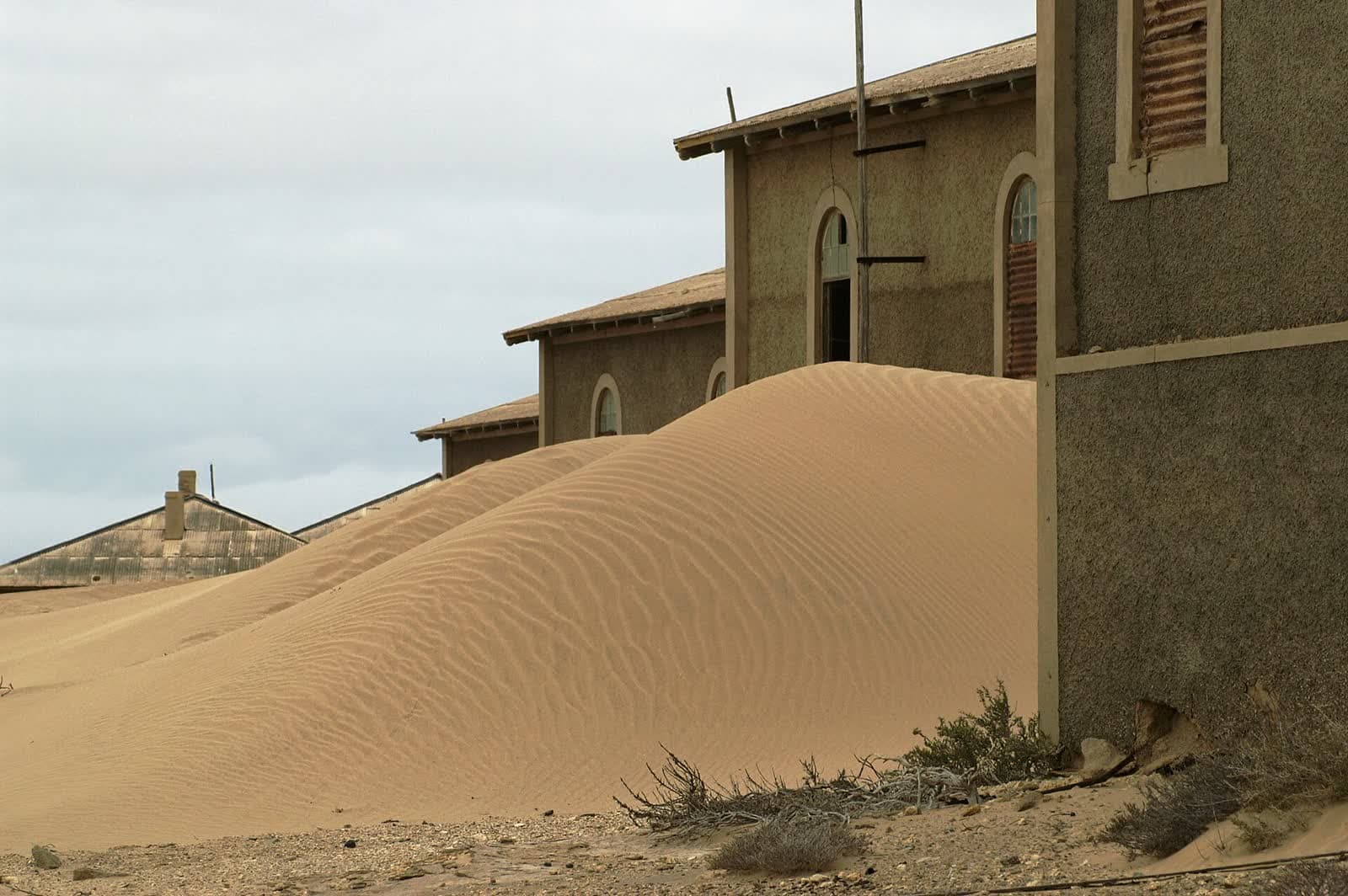
Kolmanskop, Namibia — the town in the photo up top. Diamond miners built it in the desert with a ballroom, a theatre, even an ice-making plant. When richer diamond fields turned up further south, everyone left, and the Namib started moving in. The dunes are now interior decoration.
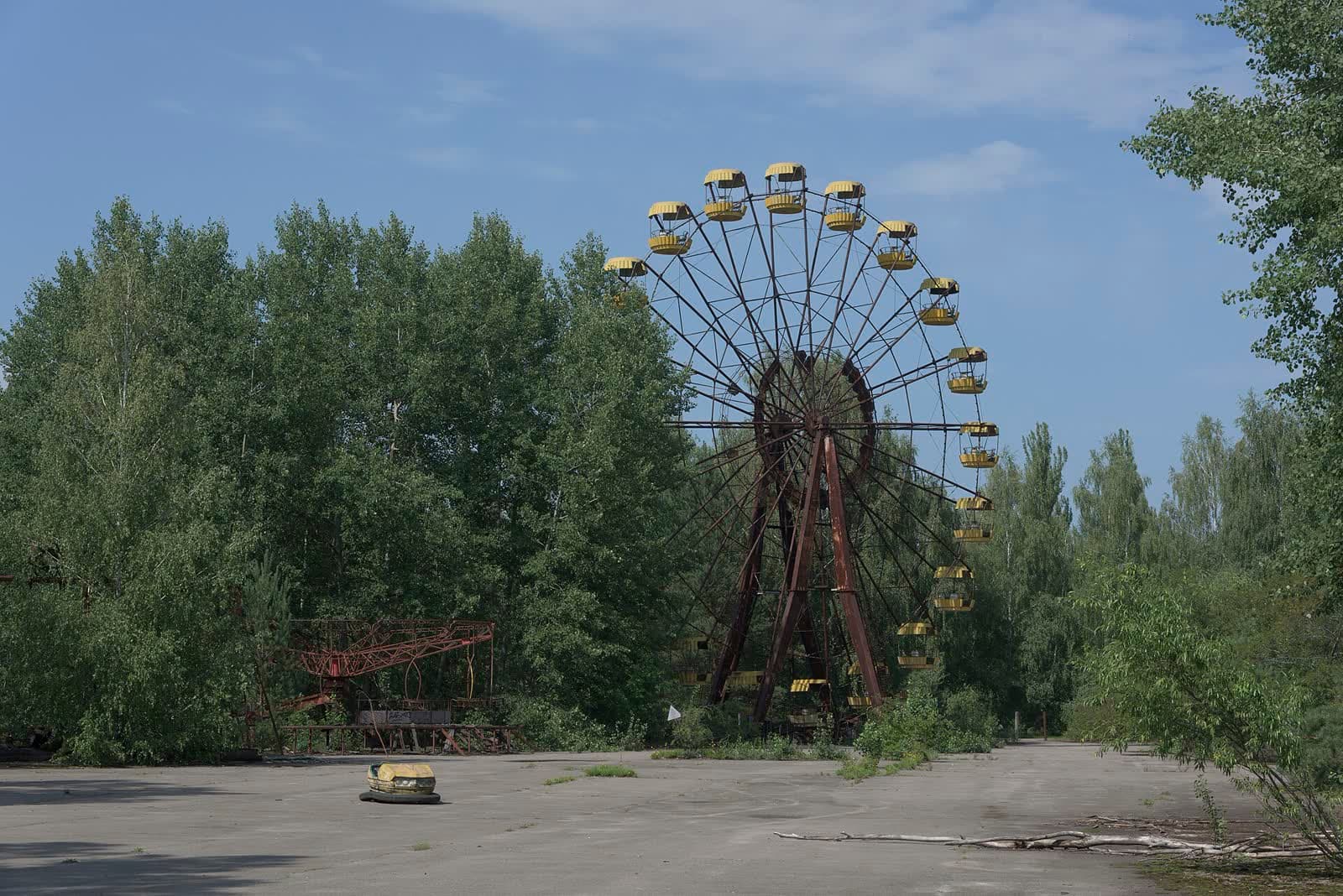
Pripyat’s amusement park was scheduled to open five days after the reactor exploded
The ferris wheel was waiting for May Day 1986. Chernobyl’s reactor 4 failed on April 26. The city of 49,000 was emptied in an afternoon — and the wheel is still standing there, never having taken a single official ride.
We did this to ourselves
A dam in China measurably slowed the Earth’s rotation
The Three Gorges Dam holds back about 40 cubic kilometres of water. Shifting that much mass changed the planet’s rotation — NASA calculated the day got longer by 0.06 microseconds. Not much. But we built something big enough to adjust the length of a day, which deserves a moment.
The Korean DMZ accidentally became a wildlife sanctuary
A 250 km strip where no one has farmed, built, or hunted for 70 years. Red-crowned cranes winter there; there are reports of bears and leopards. One of the most fortified borders on Earth is also one of its best nature reserves, by accident.
Mexico City is sinking — by up to half a metre a year
It’s built on a drained lake bed, and the city keeps pumping water out of the ground beneath itself. Some neighbourhoods have dropped metres in a generation. The cathedral has been leaning long enough that fixing it counts as restoration work.
Three to end on
Iceland has no mosquitoes
Greenland has them. Norway has them. Scotland has midges, which are worse. Iceland: zero. The leading theory blames its freeze-thaw cycles for breaking the mosquito life cycle, but honestly, scientists aren’t fully sure — which somehow makes it better.
Africa is splitting in two
The East African Rift is slowly tearing the continent apart, a few millimetres a year. In a few million years, the Horn of Africa plus a strip of east Africa heads off as its own landmass, and a new ocean fills the gap. Geology has plans; it’s just not in a hurry.
Everest is still growing
The collision between India and Asia that raised the Himalayas never stopped. Everest gains roughly 4 mm a year — though a big earthquake can undo decades of growth in a minute. The 2015 Nepal quake actually moved the mountain.
The closest people to Point Nemo are usually in space
The ocean’s most remote point sits 2,688 km from the nearest land. When the International Space Station passes overhead at 400 km up, its crew are the nearest human beings. Space agencies use the area as a spacecraft graveyard for the same reason — there’s nobody around to hit.
Where to take this
If you want these as questions instead of stories, the 50-question trivia set covers some of the same ground with the answers hidden. And the riddles about places are what happens when facts like these get dressed up in verse.